
Rama I,II,III


King Phutthayotfa (Rama I)
As the founder of the Chakri dynasty and the monarch who established Bangkok as the new capital in 1782, King Rama I consolidated the kingdom after the fall of Ayutthaya and years of political instability. He reorganized the administrative system, codified laws into what became known as the Three Seals Law, and restored religious institutions to reinforce moral and social order. By relocating the capital to the east bank of the Chao Phraya River and constructing key ceremonial and religious sites, he laid the political, cultural, and spiritual foundations for a renewed Siamese state rooted in continuity with Ayutthaya yet adapted to new realities.
King Phutthaloetla (Rama II)
King Rama II strengthened the cultural and intellectual life of the kingdom during a period of relative stability. His reign is often regarded as a golden age of literature and the arts; he personally patronized poets, artisans, and performers, helping to refine court traditions that reinforced royal prestige and social cohesion. Temples and artistic projects flourished under his support, reflecting a confident capital whose identity was expressed not only through political authority but also through refined cultural achievement.
King Nangklao (Rama III)
King Rama III presided over a period of economic expansion driven largely by maritime trade, particularly with China. Revenue from commerce financed extensive temple construction and restoration, embedding religious patronage into the kingdom’s expanding prosperity. His reign balanced traditional Buddhist kingship with pragmatic diplomacy and trade relations, strengthening the kingdom’s fiscal base and regional influence while reinforcing the sacred and moral dimensions of royal authority.
Bangkok City Pillar Shrine
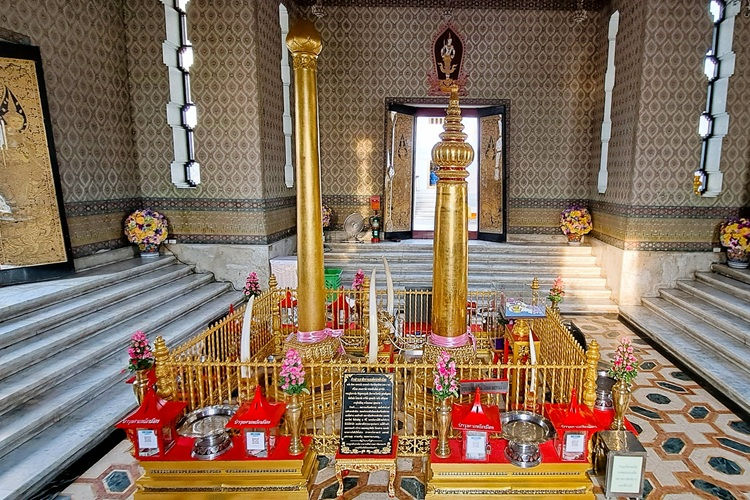
The shrine serves as the spiritual 'anchor' of the capital, representing a sacred marriage between Thai cosmology and political legitimacy. King Rama I inaugurated the site on April 21, 1782, by planting a pillar to signal the birth of the Rattanakosin Kingdom, and the divine protection of the Chakri Dynasty. Under King Rama II, the shrine evolved into an active ceremonial center reinforcing stability during a period of cultural and artistic renaissance. King Rama III further strengthened and restored the shrine, integrating it into the spiritual defenses of the Grand Palace precinct and affirming it as the metaphysical shield of the realm.
Royal Grand Palace
Established in 1782 by King Rama I, the palace was designed to mirror the grandeur of the lost capital of Ayutthaya, utilizing salvaged bricks and a similar riverside layout to symbolize the rebirth of the Thai kingdom. Rama I constructed the core Phra Maha Monthien group including the Amarin Winitchai audience hall, and the Chakraphat Phiman residence which remains the traditional site for royal coronations. King Rama II significantly expanded the palace grounds southwards toward Wat Pho and introduced elegant structures like the Sanam Chan Pavilion, further cementing the palace as a center for a cultural "Renaissance." Under King Rama III, known as the "Temple Builder," the complex was artistically enriched with extensive masonry renovations and the integration of Chinese porcelain, most notably seen in the Wiharn Yod. He also fortified the spiritual defense of the palace by commissioning the iconic demon guardian statues and the bronze Hermit statue, ensuring the Grand Palace remained a living monument to both royal authority and religious devotion.
Wat Phra Kaew (Temple of the Emerald Buddha)
King Rama I established the temple in 1782 specifically to house the Emerald Buddha, which he had recovered from Vientiane, thereby positioning the image as the protective palladium of the new Rattanakosin capital. During the reign of King Rama II, the temple became the focal point of a cultural revival; he oversaw the intricate detailing of the temple's architecture and the creation of its famous murals, ensuring the site reflected the artistic "Renaissance" of the era. King Rama III significantly expanded the temple's spiritual and physical presence by undertaking a massive restoration to celebrate Bangkok’s 50th anniversary. Most notably, he commissioned the third seasonal robe (for the winter) for the Emerald Buddha, completing the triad of gold-and-gem-encrusted vestments that the reigning monarch personally changes three times a year.
Wat Pho (Temple of the Reclining Buddha)
King Rama I laid its foundation in 1788, rebuilding the ancient Wat Phodharam to serve as a royal monastery adjacent to the Grand Palace; he famously enshrined over 1,200 Buddha images rescued from the war-torn ruins of Ayutthaya and Sukhothai here, effectively "re-centering" the spiritual heritage of the old kingdoms in the new capital. While the reign of King Rama II saw continued royal patronage and aesthetic refinement that mirrored the era’s "Golden Age" of arts, it was King Rama III who transformed the site into a monumental center of learning. Beginning in 1832, Rama III oversaw a massive 16-year renovation that included the construction of the iconic 46-meter-long Reclining Buddha and the creation of the "Stone Encyclopedia", a series of marble inscriptions covering traditional medicine, massage, geography, and poetry, designed to make knowledge accessible to the general public.
Wat Arun (Temple of Dawn)
King Rama I initially utilized the temple (then known as Wat Chaeng) as the primary royal chapel to house the Emerald Buddha before its relocation to the Grand Palace in 1784, effectively grounding the new dynasty’s spiritual authority in the site's ancient prestige. King Rama II later spearheaded a transformative "aesthetic revolution" at the temple, renaming it and personally carving the face of the main Buddha image (Phra Phuttha Dhammamisara Lokat-thidat) in the ordination hall. He envisioned a massive expansion of the central prang (tower) to reflect the grandeur of the burgeoning kingdom, though the project remained unfinished at his death. King Rama III ultimately realized this vision, raising the central prang to its iconic height of over 70 meters and meticulously decorating it with intricate mosaics of multi-colored Chinese porcelain salvaged from the ballast of trade ships, symbolizing the kingdom's prosperity and artistic mastery.
Wat Ratcha Orasaram
Wat Ratcha Orasaram reflects King Rama III’s deliberate embrace of Chinese artistic forms, a choice shaped by his deep involvement in maritime trade with China prior to and during his reign. The prosperity generated through this commerce strengthened the kingdom’s finances, and the king sought to acknowledge both the economic partnership and the presence of a significant Chinese community within the capital. Though incorporating Chinese motifs, ceramics, and architectural details, the temple remained firmly grounded in Theravada Buddhist devotion, demonstrating that openness to external influences could coexist with religious continuity and royal piety. Part of King Rama III’ ashes are interred beneath the pedestal of the principal Buddha image in the Ordination Hall.